The gemological world has its own unique culture. It has its own histories and discoveries, myths and wonders, language, and legendary personalities. Perhaps one of the most famous names in the gemological world, and certainly in that portion concerned with diamonds, is Marcel Tolkowsky. In the years since he outlined his idea of optimum diamond proportions in 1919, his name has been synonymous with "well-cut" diamonds. Even a casual glance through internet diamond retail sites reveals numerous (sometimes reverential) mentions of his name. Though many people mention Tolkowsky and his book Diamond Design [Footnote 1], few have had the chance to read this treatise, and fewer still have attempted an analysis of its strengths and weaknesses. Who was Marcel Tolkowsky? What did he say in this book? And did he actually say all the things people have attributed to him?
BIOGRAPHICAL BACKGROUND
Marcel Tolkowsky (figure 1) was born in Antwerp in 1899, on the eve of the twentieth century. He died in New York 92 years later, in February 1991,

Figure 1. Marcel Tolkowsky
almost seeing that century to a close. Marcel Tolkowsky was born into a leading family of diamond cutters, cleavers, and dealers, and was related to another important family in the world of diamonds, that of Lazare Kaplan [Footnote 2]. Initially educated at the German School in Antwerp, Marcel continued at the Lycée Français and the University of London (where he studied for a D.Sc. in engineering [Footnote 3]). In 1919, he published a book that would forever engrave his name into the annals of diamond history. Although Diamond Design was small in size (104 pages), it would have a large effect on the world of diamonds (figure 2).

Figure 2. This is the title page from Tolkowsky's Diamond Design.
THOSE WHO TRAVELED BEFORE HIM
Marcel Tolkowsky was not the first to study diamond cuts or to attempt to systematically study different diamond proportions. One predecessor was David Jeffries, who in the 1750s described a system to classify and evaluate different diamond cuts. In A Treatise on Diamonds and Pearls, Jeffries discusses "well made" and "ill made" diamonds, and states that the latter are defined by "undue substance" or "expansion." Thus, as early as 1751, certain individuals were examining the issue of what constituted "well made" diamonds.
Nor was Marcel Tolkowsky the first to use ray tracing to follow light paths inside diamonds. Max Bauer (1904), Chandler Chester (1910), Frank Wade (1917), and Herbert Whitlock (1917a,b), among others, used basic ray-tracing methods in their various articles on diamond cut. Although only Wade and Whitlock recommended detailed proportion measurements, they all commented on the lack of brilliancy that resulted when diamonds were cut either too deep or too shallow [Footnote 4]. Unlike these earlier authors, however, Tolkowsky showed the mathematical support for his ray tracing when he specified recommended proportions for round brilliant cut diamonds.
Perhaps the most significant precursor to Tolkowsky was Henry Morse (1826-1888), a diamond cutter in Boston, Massachusetts. Morse opened the first diamond-cutting factory in America (Federman, 1985). Although Morse apparently was extremely secretive about the methods and diamond proportions he used, the trade press from that time period provides some clue as to his contributions and accomplishments in the art of diamond cutting. Morse and his partner Charles Field (who developed many of the instruments that their factory used) were perhaps the first to begin to consistently cut diamonds into shapes that were different from the prevailing European cuts.
Morse-cut diamonds had smaller tables, shallower crown angles, and smaller culets than the typical diamond cut in Europe at that time. Rather than cut diamonds only to retain weight, Morse and his cutters attempted to cut every diamond to fairly consistent proportions regardless of weight loss. He accomplished this with the help of Field's innovations in diamond manufacturing machinery (e.g., the first diamond bruting machine). Morse was also concerned with attaining higher standards of symmetry, and there is some evidence to suggest that Morse was cutting diamonds [Footnote 5] that were close in proportions to what Tolkowsky would later suggest (Tillander, 1995). In some sense, Morse may have found through practice what Tolkowsky would attempt to determine mathematically.
DIAMOND DESIGN: WHAT TOLKOWSKY INCLUDED
Tolkowsky, In Diamond Design, was the first to provide a mathematical analysis of diamond cut. The book contains three parts: one on diamond history, one on the field of optics as understood at that time, and one that mathematically examines different geometric shapes in an effort to better understand round brilliant diamond proportions. Tolkowsky provided mathematical support for a new style of cutting round brilliant diamonds that was becoming increasingly popular in his time (especially in America). Different versions of this style would become known as the "Tolkowsky Cut," the "Modern Brilliant Cut," and the "American Ideal Cut." Although Tolkowsky wasn't the first to suggest diamond proportions in these ranges, he was the first to publish a mathematical foundation that supported these proportions.
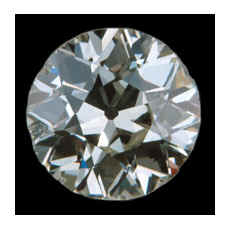
In Diamond Design, Marcel Tolkowsky combined hand-drafted ray tracing and mathematical examinations of different diamond cutting styles to support a "new" set of diamond proportions. These proportions led to different appearances than those of "Old European" and "Old Mine" cuts that were prevalent at the time (figure 3). However, Tolkowsky's proportions might not have been too different from those that had been used by Morse and others in America.
 |
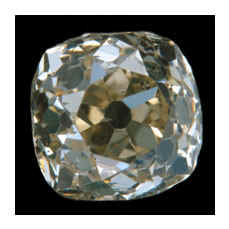 |
| Figure 3. These are face-up views of "Old European Cut" (left) and "Old Mine Cut" (right) diamonds like those that were prevalent when Tolkowsky wrote Diamond Design. The European cut diamond looks somewhat modern, but has a larger culet and a very small table (45%) by modern standards. (Since old-cut diamonds came in a variety of shapes, the diamonds above should only be considered examples of their cut types.) | |
As discussed in "Diamond Optics Part 2," Tolkowsky considered the dispersion of light rays into spectral colors, but only as they exited the diamond. Although this is an important part of the appearance aspect of fire in a diamond, it is nevertheless incomplete. In most cases, the dispersion of a light beam begins as soon as that beam strikes the diamond's outer surface [Footnote 6]. In an earlier part of his treatise, Tolkowsky acknowledged that different wavelengths (colors) of light have different refractive indices (and therefore will spread while traveling). However, when he presented his mathematical support for his proportion recommendations, he ignored internal dispersion of light within the diamond. This decision leads to a major discrepancy with the way light actually behaves in a diamond.
In "The Importance of Three-Dimensionality", we noted that Tolkowsky considered a two-dimensional representation of a diamond in his mathematical calculations. However, diamonds are three-dimensional objects; they require three-dimensional modeling. We may be ignoring the influence of more than 50% of the diamond's surface (depending on lower girdle lengths) if we only consider the facets that Tolkowsky included in Diamond Design (figure 4).

Figure 4. The two-dimensional profile used by Tolkowsky omitted
up to 50% of a faceted diamond's surface (those areas shown in
white). This two-dimensional profile is shown in red, and as a red
line through each of the images.
Because every facet has the potential to change a light ray's plane of
travel, every facet must be considered in any complete calculation of
light paths.
Just as a two-dimensional slice of a diamond provides incomplete information about the three-dimensional nature of light behavior inside a diamond, this two-dimensional slice also provides incomplete information about light behavior outside the diamond. A diamond's panorama is three-dimensional. Although diamonds are highly symmetrical, light can enter a diamond from many directions and many angles. This factor further highlights the need to reevaluate Tolkowsky's results, and to recalculate the effects of a diamond's proportions on its appearance aspects.
In the third part of Diamond Design, Tolkowsky applies the optical laws that he outlined in the previous part to various two-dimensional diamond sections. He examines rectangles, varieties of triangles representing rose-cut diamond cross sections, inverted triangles that represent cross sections of round brilliant pavilions, and then cross sections of complete round brilliants. The first section that is directly relevant to the study of round brilliant diamonds is the one in which he examines an inverted isosceles triangle (i.e., a triangle in which two sides are the same length, but the third is a different length). He uses this triangle to determine that an "optimum" pavilion angle for a "balance" of dispersed light (i.e., fire) and light strength (i.e., brilliance) is 40.75 degrees [Footnote 7]. This angle mostly applies to light rays that enter the diamond from angles close to perpendicular to the table. Tolkowsky then considers the bezel angles (which would translate into crown angles) that are needed to "fix" and ensure dispersion of those light rays that enter the diamond from oblique angles (i.e., those angles that are more parallel to the table). It is in this step that Tolkowsky determines that a crown angle of 34.5 degrees and a table size of 53% are optimal. A small part that follows discusses the addition of star facets to produce more "life" in the diamond.
Another important point to consider is that Tolkowsky did not follow the path of a ray that was reflected more than twice in the diamond. However, we now know that a diamond's appearance is composed of many light paths that reflect considerably more than two times within that diamond. Once again, we can see that Tolkowsky's predictions are helpful in explaining optimal diamond performance, but they are incomplete by today's technological standards.
In his calculations, Tolkowsky also assumed that his modeled diamond had a knife-edge girdle (that is, there are places along the girdle edge where the crown touches the pavilion) [Footnote 8]. However, most modern round brilliant cut (RBC) diamonds have thicker girdles; and light ray paths change with girdle thickness (see, e.g., Hemphill et al., 1998). In addition, Tolkowsky used a modeled diamond without a culet, which affects the behavior of light rays that reflect near this area of the diamond. Thus, ray paths calculated for a diamond with a complete knife-edge girdle and no culet might not be valid for diamonds with culets [Footnote 9] or girdles of any thickness.
DIAMOND DESIGN: WHAT IS MISATTRIBUTED TO TOLKOWSKY
Although the term "ideal" has often been used in conjunction with Tolkowsky's recommended proportions, Tolkowsky himself never used this word in Diamond Design. When outlining his recommended proportions at the end of his work, Tolkowsky used the phrases "best proportions," "well-cut brilliant," and "high-class brilliant." As early as 1916, three years before the publication of Diamond Design, Wade mentioned "ideal" brilliants and "finely-cut" brilliants interchangeably. Whitlock (1917b) also mentions "ideal proportions" and the "ideal cutting" of diamonds. Over the course of time, however, the term "ideal" has erroneously become synonymous with a variation of Tolkowsky's recommended proportions.
Also, although Tolkowsky recommended a single set of proportions [Footnote 10], he actually found a much wider range of diamond proportions acceptable. In the last pages of Diamond Design, Tolkowsky presents the proportions of five diamonds "which were all cut regardless of loss of weight, the only aim being to obtain the liveliest fire and the greatest brilliancy" (p. 101). The proportions for those diamonds are listed in figure 5, along with Tolkowsky's recommendations.

Notice that some of the proportions vary considerably from Tolkowsky's
recommendations. For instance, table sizes range from 46.9% to 61.3% [Footnote
11], and crown angles range from 33 to 35 degrees. Pavilion angles
only range from 40 to 41 degrees, which is not surprising since
Tolkowsky considered the pavilion angle to be the most important factor
in a diamond's appearance.
If any diamond is going to be compared or evaluated accurately according to Tolkowsky's recommendations, all aspects of his presentation must be considered. On the one hand, Tolkowsky recommends a single set of proportions—but it is for an RBC diamond with a knife-edge girdle and no culet. Thus, Tolkowsky's measurements and predictions will be different for any diamonds with a culet or a thicker girdle. On the other hand, if diamonds are to be judged or graded within an assumed set of "Tolkowsky ranges" in regard to their proportions, those ranges need to match the ones presented by Tolkowsky himself. And as we can see from what Tolkowsky provided, his ranges for some categories are rather wide. Remember, however, that Tolkowsky viewed the five diamonds that make up these wide ranges as the "most brilliant larger stones" he had seen.
LAST THOUGHTS
Perhaps it is time to put Marcel Tolkowsky and his work, Diamond Design, into proper perspective. Tolkowsky was a pioneer in the world of diamonds because he was the first to present a mathematical analysis of diamond cut. This analysis supported new trends in diamond cutting that were taking place at the time (especially in America). However, many discoveries and innovations have been attributed to Tolkowsky that he was not the first to suggest, or, in some cases, did not suggest at all. Although it is time for an honest reevaluation of Tolkowsky, one thing is certain: Marcel Tolkowsky contributed fundamentally to the design and acceptance of the standard round brilliant.